Beschwerdemanagement: Unternehmen analysieren wiederkehrende Kundenbeschwerden und organisatorische Ursachen

When Customer Complaints Reveal Everything – Yet the Organisation Still Changes Nothing

Why organisational structures determine whether complaint management makes a difference

Customer complaints are among the clearest signals a company can receive from its customers. They arise when customer expectations and experiences diverge, when processes create friction, when products behave differently than expected, or when internal decisions have negative consequences for customers that have long remained invisible within the organisation. In short, complaints reveal far more than the need to resolve an individual case.

Over recent years, many companies have made considerable progress in systematically analysing these signals. Complaint reasons are categorised, customer interactions are examined, root causes are discussed, and customer journeys are used to identify recurring points of friction. Many of our clients already have a sophisticated methodological toolkit in place, often with an impressive level of detail.

This makes one phenomenon we observe across different organisations all the more striking: certain types of complaints remain remarkably consistent in both frequency and content for years. Employees know about them. Managers know about them. Complaint management teams have reported them repeatedly. In many cases, proposals for improving the customer experience have existed for some time. Yet the same problems continue to occur.

At this point, further optimising analytical methods or tools often delivers only limited value. A more interesting question emerges: why does an organisation continue to reproduce a problem when it has long understood its consequences?

This is precisely where the principle “Organisation beats methodology” becomes relevant.

Good Methods Can Achieve a Great Deal – But They Cannot Make Decisions

Customer-centric methods serve an important purpose. They make customer experiences visible, structure observations and help identify meaningful connections between individual incidents. A well-executed customer journey analysis can reveal where an experience repeatedly breaks down. Root cause analysis can examine different explanations. Complaint data can demonstrate that a problem is far from an isolated incident.

All of this is valuable. It should not, however, be confused with an organisation’s ability to change.

A method cannot allocate responsibility. It cannot resolve conflicting objectives between departments, create IT capacity or decide which initiative should take priority. A method can reveal that change is necessary. Whether that change actually happens depends on the organisation.

This limitation becomes particularly apparent in complaint management because the journey from customer feedback to structural improvement almost inevitably involves several departments.

Consider an example from one of our projects with an insurance company. The proportion of complaints relating to its claims reporting team had been increasing over an extended period. The main causes were known, and improvement ideas were already available. Nevertheless, meaningful change failed to materialise consistently. Technical dependencies, required approvals and competing priorities repeatedly prevented progress across the departments involved.

The decisive improvement did not come from another analysis of the problem. Instead, a cross-functional team was established with clear responsibility. Technical dependencies were addressed collaboratively, and decision-making authority for the relevant customer journey was allocated transparently. Only then could the customer experience improve sustainably.

The case is particularly revealing because the methodology had already fulfilled its purpose. The organisation knew enough. What it lacked was the ability to turn that knowledge into committed action.

Resolving Individual Complaints Professionally Can Conceal Structural Problems

Complaint management is rightly assessed on whether customers receive appropriate responses, cases are examined carefully and reliable solutions are delivered. Operational quality is both necessary and essential. At the same time, however, it can create an effect that makes organisational learning more difficult.

When a customer encounters a problem in a process, subsequently reaches a competent contact in sales or customer service and eventually receives a solution, the immediate damage is limited. The company has delivered a result – but only at the point where it has compensated for a problem it created earlier.

A few weeks later, another customer encounters exactly the same issue. The process starts again. This complaint may also be resolved exceptionally well. From a case management perspective, there have been two successful resolutions. From an organisational perspective, the underlying cause remains unchanged.

In this way, effective complaint management can become a kind of shock absorber. It absorbs the consequences of complicated processes, unclear product descriptions, problematic handovers and technical failures. The more professionally this compensation works, the less pressure the rest of the organisation may feel to change.

This is not an argument against excellent service or swift complaint resolution. Quite the opposite. It simply demonstrates that resolving individual cases and enabling organisational learning follow different logics. One asks how the customer’s immediate problem can be solved. The other asks why the organisation keeps producing the same type of problem.

When Problems Fall Between Areas of Responsibility

In our experience, the most persistent complaint patterns often arise where responsibility cannot be assigned exclusively to a single department.

What do we observe? Customer service experiences the consequences of a problem but has no control over the underlying process. IT understands a technical dependency but can only implement changes when a business department prioritises them. Product management considers a description intuitive from a product or risk perspective, while customers repeatedly struggle with precisely that description.

Each individual position may be entirely reasonable. Nevertheless, the customer experience remains poor.

This is one of the central challenges of Customer Experience Management: customers experience journeys end to end, while organisations distribute responsibility according to internal functions, systems and departmental boundaries. This division of labour becomes problematic when no mechanism exists to reconnect these perspectives.

A recurring complaint pattern can make such organisational gaps particularly visible. Rather than pointing to a failure within one department, it may reveal a weakness at the interfaces between departments.

In our Customer Code, we describe the necessary change in perspective through organisational hypotheses. Instead of immediately deriving a corrective action from a complaint, the first step is to examine which structural logic might be producing the observed pattern. Fragmented responsibility may be just as relevant as conflicting objectives, decision-making bottlenecks or routines that appear reasonable from an individual department’s perspective but collectively create a poor customer experience.

This changes the quality of the analysis. Rather than asking which individual process step is defective, we begin asking why the organisation repeatedly produces the same outcome at a particular point in the customer journey.

Bereichsübergreifende Zusammenarbeit zur Lösung von Problemen in der Customer Journey

An Example: When Communication Is Only the Visible Symptom

This becomes especially apparent in complaints about contradictory or confusing information. The obvious response is often to improve communication. Employees receive additional training, texts are revised, FAQs are expanded and further quality assurance measures are introduced.

Such measures can be useful. However, they fall short when contradictory communication is merely the visible consequence of different internal operating logics.

Another example described in our Customer Code illustrates this situation at an energy supplier. Customers repeatedly complained about contradictory contractual information. At first glance, this appeared to be a communication problem. Closer examination revealed that sales and billing were applying different rules to the relevant contractual clause, and there was no clear end-to-end responsibility for ensuring contractual clarity.

Additional training might have helped employees explain the contradictions more effectively. It would not have eliminated the contradictions themselves.

Only changes to responsibilities, the standardisation of the relevant process and clearly defined decision-making rights addressed the structural cause.

Cases like these are particularly valuable for those responsible for complaint management. They can reveal how responsibility is distributed, how systems interact and which principles guide decisions within the organisation. The important thing is not to focus too quickly on improving case handling and response quality alone.

At Some Point, More Analysis Becomes Part of the Problem

When faced with uncertainty, organisations understandably tend to respond with further analysis. If a complaint issue persists, data is examined in greater detail, categories are refined and additional workshops are organised. This makes sense as long as genuinely decision-relevant knowledge is still missing.

But only then.

The situation becomes more difficult when the essential connections are already understood and additional analysis primarily serves to postpone a decision.

Extensive action lists are created without clarifying which decision is actually required. An issue moves through committees, receives different assessments and is repeatedly passed on to new stakeholders. The organisation remains intensely occupied with the problem without changing the conditions that produce it.

At this point, a different perspective is needed. The question is no longer which additional method might generate further insights. What matters is identifying the organisational prerequisite that is missing and preventing existing knowledge from leading to action.

Perhaps there is no clear mandate. Perhaps end-to-end responsibility is unclear. There may be no decision-making forum in which several departments can genuinely balance their competing interests. In other cases, the issue appears on the agenda but repeatedly loses out to other priorities.

These situations have little to do with the quality of complaint analysis. They describe the organisation’s capacity for change.

Turning Complaint Patterns into Decision-Ready Insights

This is why effective complaint management does not end with identifying a pattern. It must consolidate observations into a form that enables an informed organisational decision.

The sequence Signal → Pattern → Hypothesis → Decision Proposal serves an important purpose in translating customer feedback into organisational action.

Beschwerdemanagement Prozess: Signal, Muster, Hypothese und Entscheidungsvorschlag – O'Donovan Consulting

Individual customer comments are first consolidated into a recurring pattern. This pattern must not be mistaken prematurely for its underlying cause. Instead, it becomes the basis for a testable hypothesis about the structural conditions behind it. Only then can a meaningful decision proposal be developed.

This significantly changes the role of complaint management. It does not become product management or process management, nor does it need to take over the decision-making authority of other functions. Its role can, however, be to translate customer reality into insights that other parts of the organisation can act upon.

A statement such as “Complaints about this issue are increasing” has a very different quality from identifying a recurring breakdown at a specific point in the customer journey, recognising that several departments are involved and developing a concrete hypothesis about an underlying gap in responsibility.

A decision proposal goes one step further by specifying which responsibility needs clarification, which priority must be established or which cross-functional decision is required.

This is how knowledge from complaints becomes knowledge the organisation can use.

The Crucial Question: Who Can Make the Decision?

This is where it becomes particularly clear why organisation beats methodology.

Even an excellent decision proposal achieves nothing if nobody makes – or is able to make – the necessary decision. That is why simply including complaint patterns in management reporting is insufficient. A report creates visibility, but it does not automatically create a space for decisions.

Organisational impact emerges when responsibility, authority and decision-making processes are aligned. Where complaint causes cross departmental boundaries, this often requires someone to assume end-to-end responsibility without necessarily having hierarchical control over every function involved.

What is needed is a legitimate forum in which conflicting objectives can be discussed openly, priorities can be weighed against one another and resources can be committed. In other words, a place where decisions are not only made but also implemented.

That is the difference between another improvement meeting and effective governance.

A quality circle may analyse a problem exceptionally well. A task force may bring the relevant stakeholders together. A customer journey community may facilitate knowledge sharing. What ultimately matters, however, is whether meaningful decisions can actually be made somewhere within the organisation.

The number of committees is certainly no indication of an organisation’s ability to learn. The decisions they actually produce are far more revealing.

Führungskräfte klären Verantwortlichkeiten und Entscheidungen zur Verbesserung des Kundenerlebnisses

Complaint Management Becomes a Sensor for Organisational Quality

Viewing complaints from this perspective also changes their strategic significance.

They continue to show where customers are dissatisfied. At the same time, they become a kind of stress test for the organisation itself.

A recurring complaint issue can reveal whether responsibilities work, whether departments share common objectives, whether end-to-end problems have a clear owner and whether known causes can actually be prioritised.

This is why, when examining persistent complaint patterns, we do not focus exclusively on the customer experience. We also look closely at what the organisation’s response to those patterns reveals about how it operates.

Perhaps the most important insight is that nobody is responsible for the handover between two departments. Or that an issue has been known for years but cannot gain sufficient priority within the existing organisational structure.

In this way, complaint management becomes a source of insight into the organisation itself.

Success Is Measured by Whether the Pattern Disappears

This has consequences for how success in complaint management is measured.

Handling times, compliance with deadlines and customer satisfaction with complaint resolution remain important performance indicators. However, evaluating organisational learning requires an additional perspective.

If a structural cause has been addressed, the results should eventually become visible in the complaint pattern.

Repeat contacts decline. Escalations become less frequent. Employees need fewer workarounds. The relevant breakdown in the customer journey should become less significant. Ideally, the number of complaints relating to that specific issue will eventually decrease as well.

This shifts the measure of success from resolving an individual case to reducing the likelihood of the same problem occurring again.

In our view, this perspective is more demanding, but also more effective. It means that responsibility for complaints no longer rests exclusively with complaint management. Instead, it becomes a shared organisational responsibility.

Organisation Beats Methodology

Customer complaints provide companies with an exceptionally direct view of where their promises to customers diverge from customers’ actual experiences. Good methods help interpret these signals, recognise patterns and investigate plausible causes.

But their impact ends where the organisation must take over.

From that point onwards, the challenge is about responsibility, priorities, decision-making capability and collaboration. Even better analysis cannot replace these requirements.

“Organisation beats methodology” therefore does not mean that methods are unimportant in complaint management. It means understanding their possibilities and limitations realistically.

Methods and tools create insight and direction. Whether that insight leads to meaningful change depends on the organisation’s ability to absorb it and translate it into committed action.

Perhaps this is the most demanding form of complaint management: not simply responding to the same problems more quickly and professionally, but enabling the organisation to learn from recurring complaints so effectively that certain problems eventually stop occurring altogether.


Turn Customer Complaints into Meaningful Organisational Change

Many organisations already know where customers repeatedly encounter the same problems. Yet between identifying an issue and achieving meaningful change, there are often unclear responsibilities, organisational silos and decisions that never get made.

How well is your organisation equipped to turn customer insights into action?

Our CX Governance Check helps you take the next step. Examine a recurring complaint pattern, explore the organisational structures behind it and develop a concrete decision proposal that can help your organisation move forward.

In just 10–15 minutes, using a real case from your own organisation.

Start the CX Governance Check

Prefer to Discuss Your Challenges Directly?

If you would rather explore your organisation’s challenges in a personal conversation, you can arrange a free, no-obligation consultation with Matias Musmacher, Executive Board member at O’Donovan Consulting AG and author of this article.

Together, you can discuss where your organisation already has the necessary insights but still struggles to translate them into effective change.

Book a No-Obligation Meeting with Matias Musmacher

BPO of the future Flyer

BPO of the Future: What Will the Customer Service of Tomorrow Look Like?

Five providers, five perspectives and one central question: What will a BPO provider need to deliver in the future?

Customer service is changing. Artificial intelligence is taking over tasks that, just a few years ago, could only be handled by people. Automation is transforming processes, new technologies are enabling different forms of customer communication, and expectations around accessibility, quality and efficiency continue to rise.

For businesses, this raises a question that goes far beyond choosing the right contact centre technology: How should customer service be organised in the future – and what role will external service providers play?

This is precisely what the online event “BPO of the Future – Providers in Direct Comparison”, organised by the i-CEM Institute for Customer Experience Management, will explore on 29 October 2026.

Five BPO providers will present their perspectives on the future of their industry and professional customer service. Matias Musmacher, a member of the Executive Board at O’Donovan Consulting, will moderate the event alongside Roland Ruf from RUF Beratung. The aim is not simply to showcase different approaches, but to put them into context and examine them critically.

Because the real question is not whether Business Process Outsourcing is changing.

It is how.

When Customer Service Changes, Outsourcing Must Change Too

Business Process Outsourcing, or BPO, has been an established model in customer service for many years. Companies outsource parts of their customer communications or entire service processes to specialised providers that supply the people, technology and operational structures required.

Traditionally, the focus has been on capacity, availability, service quality and cost efficiency. These factors remain important. However, as AI and automation create new possibilities, the foundations on which businesses design and manage their customer service operations are changing.

When routine enquiries can increasingly be handled automatically, the nature of work in contact centres changes. When AI supports employees during customer interactions, new requirements emerge for skills, processes and leadership. And when customer interactions take place across a growing number of channels, optimising individual touchpoints in isolation is no longer enough.

For BPO providers, this means continuing to develop their services and operating models.

For the companies working with these providers, it creates a new challenge: understanding which approaches genuinely support their customer service strategy.

The BPO provider of the future will not be judged solely on how efficiently it handles customer interactions. Its contribution to the overall customer relationship will matter just as much.

AI in Customer Service: Between Technological Promise and Operational Reality

Hardly any discussion about the future of customer service takes place without mentioning artificial intelligence.

And understandably so. AI offers opportunities to classify customer enquiries, make information available more quickly, support employees and automate certain interactions.

But there is often a considerable difference between an impressive technology demonstration and a customer service operation that works reliably every day.

A solution needs to do more than function technically. It must integrate with existing processes, make commercial sense and meet customer expectations. It also needs to work when an enquiry falls outside the standard scenario or when a customer needs support that cannot simply be automated.

That is why new AI solutions deserve closer examination.

Which tasks are genuinely being automated? Where is service quality improving? How is collaboration between people and technology changing? And what impact do these developments have on the business model of a BPO provider?

These are the questions businesses need to answer as they develop their customer service operations and choose the right partners to support them.

BPO of the future Flyer

Five BPO Providers. Five Different Visions of the Future.

At the “BPO of the Future” online event, five providers will come together to present their perspectives on tomorrow’s customer service landscape.

Participants include REACH XCEL, hey contact heroes, Samhammer and Ströer X, alongside another new market entrant.

Each provider will have 20 minutes to demonstrate the solutions and service models they are developing, explain their approach to AI and automation, and explore the role people will play in the future of customer service.

What makes this format particularly interesting is the direct comparison.

Businesses exploring the future of Business Process Outsourcing are often presented with individual perspectives. Each provider introduces its own technologies, services and vision.

Comparing those perspectives is considerably more challenging.

Where do the approaches genuinely differ? Which developments are viewed similarly across providers? What new opportunities are emerging for businesses? And which concepts can already be implemented successfully in day-to-day operations?

This is where the event offers particular value. Rather than five separate presentations, it provides a broader view of how the market is evolving.

Matias Musmacher to Moderate the Discussion Alongside Roland Ruf

Matias Musmacher, a member of the Executive Board at O’Donovan Consulting, will moderate the event together with Roland Ruf, Managing Director of RUF Beratung.

Both bring many years of experience in customer service, customer experience and the development of service organisations.

Their role goes beyond simply guiding participants through the programme. They will help put the different perspectives into context, identify similarities and differences, and ask critical questions where an attractive vision of the future needs to translate into a viable business and operating model.

For companies looking to develop their customer service strategy, technological possibilities are only part of the picture.

The discussion must also address how relationships between businesses and their BPO partners are changing. What responsibilities will external providers take on? Which capabilities should remain within the organisation? And how can efficiency, service quality and customer experience be brought together in a meaningful way?

People Remain Central to the Future of Customer Service

For all the excitement surrounding automation, it is worth considering the people who make customer service possible every day.

As AI takes over simple and repetitive tasks, the demands placed on customer service employees are changing. Complex enquiries, emotionally sensitive situations and cases requiring individual support will not simply disappear.

If anything, these interactions may become even more important.

For BPO providers, this raises questions about how they develop, support and lead their employees. Which tasks should technology take over? Where does human judgement remain essential? And how can organisations create working conditions in which people and AI collaborate effectively?

The future of customer service is therefore not simply a question of technology.

It is equally a question of organisational design, leadership and customer experience.

And it affects businesses regardless of whether they operate customer service entirely in-house, outsource individual processes or work with several external partners.

BPO of the Future: A Morning Dedicated to Tomorrow’s Market

Businesses looking to develop their customer service operations need a clear understanding of the opportunities available and how expectations of external service partners are evolving.

The online event “BPO of the Future – Providers in Direct Comparison” offers a focused opportunity to explore these questions.

On 29 October 2026, from 10:00 am to 12:30 pm, five providers will present their visions for the future. The event will conclude with a joint discussion bringing together the moderators and representatives of the participating BPO providers.

We are delighted that our Executive Board member Matias Musmacher will help guide this exchange alongside Roland Ruf, contributing his experience in customer service and customer experience consulting.

Because ultimately, the event addresses a question that is likely to become increasingly important for businesses in the years ahead:

What will genuinely distinguish the BPO provider of tomorrow from the BPO provider of today?

The answers promise valuable insights into the next developments in customer service.

Register Now – Free of Charge

BPO of the Future – Providers in Direct Comparison

Date: 29 October 2026
Time: 10:00 am–12:30 pm (German time)
Format: Online event
Moderators: Matias Musmacher (O’Donovan Consulting) and Roland Ruf (RUF Beratung)
Participation: Free of charge

Register for the “BPO of the Future” online event

We look forward to five different perspectives, a direct comparison and an engaging discussion about the future of customer service.

Podcast Cover CX-Talks

The Customer Code: Why Organizational Structures Can Hold Back Customer Experience

Companies today know more about their customers than ever before.

Customer journeys reveal pain points. Feedback systems continuously provide insights. NPS, CRM data and service analytics show where expectations are not being met.

And yet, some known customer problems remain unresolved for years.

Why?

That is exactly what Matias Musmacher and Holger Heinze from O’Donovan Consulting discuss with Peter Pirner in the latest episode of the CX-Talks podcast.

At the heart of the conversation is a key idea from their book “The Customer Code”:

Customer Experience often does not fail because companies lack the right methods. It fails because the organization is unable to consistently turn customer insights into action.

When the organization cannot act on what it knows

In many companies, there is no shortage of customer knowledge.

Customer service teams know the recurring complaints. Marketing analyzes customer behavior. Sales understands objections and expectations. IT knows the technical limitations. Product teams understand requirements and usage patterns.

The knowledge is there.

The challenge begins when this knowledge is supposed to lead to actual change.

Then different questions arise:

  • Who can make a decision that affects multiple departments?
  • Who takes responsibility for a pain point that spans several teams?
  • What happens when customer needs conflict with internal targets?
  • How quickly can the organization adapt its processes?
  • What happens when existing structures stand in the way of a better customer journey?

At this point, Customer Experience becomes an organizational question.

What is the Customer Code?

The Customer Code describes the internal logic of an organization.

How is information processed? How are decisions made? How are priorities set? How do departments collaborate? And how effectively can the organization respond to relevant customer signals?

Two companies can receive exactly the same customer feedback and react to it in completely different ways.

One organization changes a process within a few weeks. In another, the same issue moves through meetings, responsibilities and approval processes without anything actually changing.

The difference is not necessarily the quality of the customer insight.

It is the organization’s ability to turn that insight into action.

Organizational structure becomes part of the Customer Experience

Customers are generally not interested in how a company is organized internally.

They do not experience organizational charts.

They experience waiting times, handovers, conflicting information, disconnected systems and complicated processes.

That is why internal structures have a direct impact on Customer Experience.

Marketing, sales, service and IT can each perform well against their individual targets.

And yet the customer may still experience a fragmented journey.

The reason is simple: the customer journey does not follow the organizational chart.

Conway’s Law and the customer journey

In the podcast, Matias Musmacher and Holger Heinze also discuss Conway’s Law.

In simple terms, Conway’s Law describes the observation that organizations tend to create systems that reflect their own communication and organizational structures.

This idea is particularly relevant to Customer Experience.

If an organization operates in strong silos, these boundaries can often be found in its processes, IT systems and ultimately in the customer journey.

Improving Customer Experience can therefore require more than redesigning individual touchpoints.

It may also require changing the way people and departments work together.

The episode also explores the Reverse Conway Maneuver: deliberately designing organizational structures and collaboration in a way that better supports the desired outcome.

How customer-centric is an organization really?

Another topic in the episode is O’Donovan’s customer-centricity maturity model.

The important question is not simply whether an organization uses customer journeys or collects customer feedback.

What matters is what happens afterwards.

A useful question for any organization is:

What actually happens when an important customer signal appears?

Is a decision made?

Do priorities change?

Do different departments work together on a solution?

Or does the problem remain unresolved even though everyone already knows about it?

These reactions can tell us much more about an organization’s actual level of customer centricity than mission statements or strategy documents.

Change stability instead of permanent change projects

Organizations need to be able to change without constantly operating in a state of emergency.

In the podcast, Matias Musmacher and Holger Heinze discuss the concept of change stability and the capabilities organizations need to deal with continuous change.

This is particularly relevant to Customer Experience.

Customer expectations change. Technologies change. Competitors introduce new services and set new standards.

Customer centricity therefore cannot be treated as a project with a defined end date.

Organizations need the ability to continuously identify relevant customer signals, evaluate them and translate them into action.

A simple experiment in customer service

Sometimes small experiments can reveal how strongly organizational structures influence behavior.

One example discussed in the podcast involves goodwill policies in customer service.

Situations like these make decision-making authority very tangible.

How much freedom do employees actually have when solving a customer’s problem? Which rules determine their behavior? And what happens when helping the customer conflicts with an internal policy?

There can be a considerable gap between saying “We are customer-centric” and answering the much more practical question:

“What is an employee actually allowed to decide in this situation?”

This is where organizational design becomes tangible.

Customer Experience and organizational development belong together

Customer Experience is often discussed in terms of methods.

Customer Journey Mapping, Voice of the Customer, personas, service design and experience measurement are all valuable tools.

But these methods cannot solve organizational problems on their own.

A customer journey can reveal where a problem exists.

It cannot clarify responsibility.

A dashboard can measure a pain point.

It cannot resolve conflicting objectives between departments.

Customer feedback can highlight the need for action.

It cannot make the decision.

This is why Customer Experience Management and organizational development need to be considered together.

Podcast Cover CX-Talks

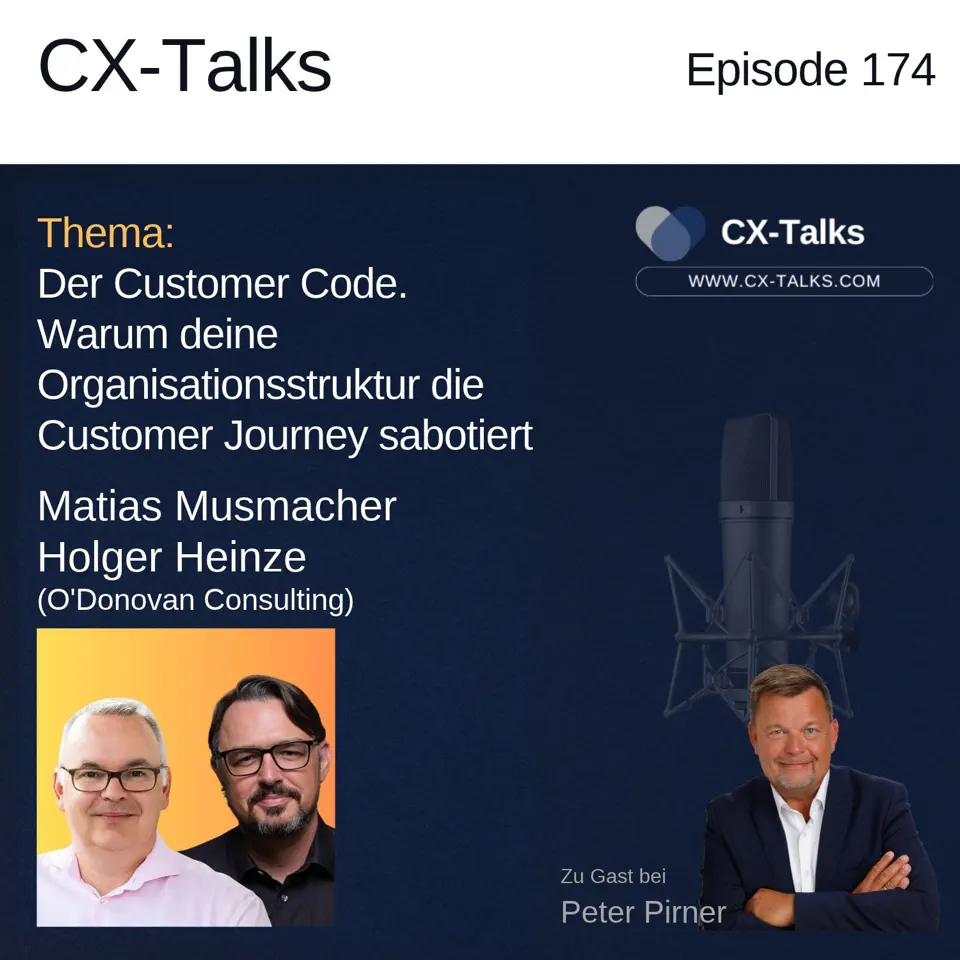
In episode 174 of CX-Talks, host Peter Pirner talks with Matias Musmacher and Holger Heinze about “The Customer Code” and why organizational structures can either enable or prevent a great customer journey.

The 67-minute conversation covers topics including:

  • O’Donovan’s customer-centricity maturity model
  • Conway’s Law and the Reverse Conway Maneuver
  • change stability
  • how to deal with organizational resistance to change
  • a practical experiment involving goodwill policies in customer service

Listen to the complete episode here:

https://cx-talks.podigee.io/196-neue-episode

If you would like to explore the topic further, our article “Why Customer Centricity Fails and Why the Problem Is Rarely the Customer” takes a closer look at how organizations can turn customer knowledge into effective decisions.

Daniel Kessler

Daniel Kessler Becomes Partner at O’Donovan Consulting

Some career moves don’t mark the beginning of something new. They make visible what has already been developing over many years.

That is exactly the case with Daniel Kessler: Daniel is becoming a Partner at O’Donovan Consulting AG and will also become a shareholder in the company.

For us, this step is about much more than a new position or title. It reflects a collaboration that has grown through shared client projects, the responsibility Daniel has already been taking on for a long time, and the mutual trust to shape the future of O’Donovan even more closely together.

From the first client project to Partner

Daniel’s journey with O’Donovan didn’t begin with a traditional job application. It began where a significant part of our collaboration still takes place today: with a client.

What started as a joint project quickly developed into a closer working relationship. More projects followed, responsibilities grew – and collaboration evolved into a long-term shared perspective.

Ingo O’Donovan, CEO of O’Donovan Consulting AG, particularly remembers how Daniel took responsibility for major client projects early on:

“I still remember when Daniel took on his first major client project a few years ago – and how quickly it became clear that he is an excellent project manager. Since then, he has developed even further. He manages several major client projects in challenging environments at the same time and systematically turns contacts from his network into long-term clients. But I value just as much how he does it – down-to-earth, without putting himself in the spotlight, and with a word you can rely on. To be honest, his move to Partner, now with shares in the company, didn’t come as a surprise to me – it was more than due. I’m simply delighted that we’ll now continue building O’Donovan together.”

That final thought captures what this step is really about: continuing to build O’Donovan together.

Because for us, partnership is not just about having a stake in the business. It means taking responsibility for our clients, for our team and for the development of the company.

Partnership is built on trust

Daniel’s perspective on the past few years also shows how this journey has grown organically on both sides. His connection with O’Donovan likewise began with a joint client project – and developed from there:

“I still remember the moment I first got to know O’Donovan while working together on a client project. In a short period of time, that initial collaboration grew into so much more. Deep trust, shared values and goals, and an enormous sense of reliability have shaped our relationship from the very beginning. This foundation, combined with a fantastic team, motivates me every single day. I experience this sense of collaboration not only internally, but especially in our daily work with and for our clients. I’m very much looking forward to actively shaping our shared journey in my new role as Partner and continuing to develop O’Donovan.”

Trust, shared values and reliability are not secondary considerations. Particularly in consulting, the quality of a working relationship is not determined by concepts and methodologies alone. It also shows in the willingness to take responsibility, in being able to rely on one another, and in standing by the commitments we make to our clients.

Daniel has continuously expanded this responsibility over the past few years. He manages major client projects even under challenging conditions and develops existing contacts into long-term client relationships.

Now, the formal next step follows.

More responsibility for the future of O’Donovan

With his appointment as Partner and his participation as a shareholder, Daniel will take on even greater entrepreneurial responsibility for O’Donovan Consulting AG.

For us, this is not about reinventing everything.

Instead, we want to continue developing what already defines the way we work: staying close to our clients, taking ownership rather than passing responsibility on, and supporting organisations through change in a way that creates tangible impact.

And, of course, it is about continuing to develop O’Donovan as a company together.

With new ideas. With a strong team. With long-term client relationships. And with people who don’t only take responsibility when things are going well.

Welcome to the Partner team, Daniel

Daniel, we’re delighted to be taking this next step together.

And above all, we’re looking forward to continuing to build O’Donovan together.

Congratulations on becoming a Partner – and here’s to everything still to come. 🧡

Odonovan Team 2026

Team Offsite in the Black Forest: Stepping Away from the Daily Routine

Some topics need a little distance from the daily routine before you can really give them the attention they deserve.

That’s why, once again this year, it was time for us to swap our desks for the Black Forest. 🌲

For the third time, our O’Donovan Consulting team offsite took us to the Black Forest. A few days together in one place, away from our usual routines, with more time for the things that can easily get lost between client projects, meetings and the day-to-day business.

For us, the offsite isn’t simply about exchanging the office for a nicer setting. It’s an opportunity to bring different things together: focused work on our client projects, team activities and dedicated time for the questions and topics that matter to us as a company.

Where are we right now? What is working well? Where do we want to develop further? And which topics do we want to move forward together over the coming months?

These conversations are an important part of our team offsite. Because collaboration isn’t built simply by working on projects together. It also grows when we deliberately make time for one another and for our development as a team.

Great collaboration also happens between meetings

Of course, our offsite wasn’t all about work.

Alongside client projects, workshops and the topics shaping O’Donovan, there was plenty of time for shared activities, good food and, above all, conversations that don’t always find enough space in the normal working day.

And perhaps those moments are just as important as the things on the agenda.

Over dinner. During an activity. Or in a conversation that was supposed to last five minutes and somehow turned into something much longer.

After all, a strong team isn’t built only in the next scheduled meeting. Collaboration also develops in all those small moments in between.

Team culture can’t be mandated

As an organisational consultancy, we work with collaboration, leadership, change and organisational culture every day. And one thing we see time and again is this: culture isn’t created by putting it on a slide.

It shows in how people work together. In how openly they can talk to one another. In how they deal with different perspectives. In how decisions are made. And in whether there is room for personal relationships alongside the work itself.

A team offsite, of course, doesn’t automatically answer all of these questions.

But it creates something that is incredibly valuable in everyday working life: time together in a different context.

And sometimes that is exactly what it takes for conversations, thoughts and ideas to emerge that simply wouldn’t have found the space between two meetings.

A few days that stay with us

After a few intensive days in the Black Forest, we returned to our daily routines with new ideas, shared experiences and a number of topics that we will continue to work on together.

But above all, we came back with memories of a genuinely great time as a team.

A big thank you to the entire O’Donovan Consulting team for these days. 🧡

After our third offsite in the Black Forest, we’re already looking forward to everything that lies ahead. 😊

Digitale Wallet-Pässe als direkter Kommunikationskanal im Reisevertrieb

When Loyalty Becomes a Real Customer Relationship

Falko May from O’Donovan Consulting joins “Travelholics – Der Podcast der Touristik”

Collect points. Receive vouchers. Install an app. Get regular newsletters.

That is how many loyalty programmes work.

There is nothing fundamentally wrong with that. An incentive can be a good reason to join a programme. Discounts, vouchers or exclusive benefits provide a tangible entry point into a customer relationship. They give customers a reason to register and share data with a company.

But that is where the real work begins.

Because a loyalty card is not yet a customer relationship.

In the latest episode of “Travelholics – Der Podcast der Touristik”, Roman Borch talks to our colleague Falko May about Customer Centricity, Customer Engagement, Loyalty and how technology is changing customer relationships in the travel industry.

At the heart of the conversation is a question that reaches far beyond tourism:

When does a customer programme actually become a relationship?

Customer knowledge begins when assumptions meet data

Falko has been working with CRM, Customer Insights and Customer Engagement for many years. During his time at Thomas Cook, his team analysed existing customer data and compared the insights with the customer profiles and assumptions that had developed within the company over the years.

Analyses like these can be sobering.

Companies often believe they know their customers extremely well. Marketing has its target groups. Sales has years of experience. Product teams believe they know what their customers want. Executives have a sense of who buys and why.

Then the data arrives.

And suddenly, some of those assumptions no longer hold true.

This is one of the central challenges of genuine customer centricity: instead of defending our existing image of the customer, we need to be willing to let actual customer behaviour correct it.

That sounds obvious. In practice, it is anything but.

Customer Centricity does not simply mean knowing more about customers. It means making different decisions based on that knowledge.

And at that point, customer centricity is no longer just a CRM or marketing topic.

It becomes an organisational one.

Kundendaten und Customer Insights als Grundlage für echte Kundenzentrierung

The customer does not experience departments

The travel industry makes the gap between the customer perspective and the organisational perspective particularly visible.

For the traveller, there is simply a journey.

It might begin with inspiration, followed by consultation, booking, preparation, departure, the stay itself and eventually the journey home.

From a company’s perspective, however, the very same journey looks completely different.

There may be a travel agency, tour operator, airline, hotel, insurer and transfer provider involved, alongside different systems, databases and responsibilities.

But the customer does not experience a system landscape.

They do not experience an organisational chart.

They experience one connected journey.

And this is precisely why Customer Experience so often breaks down at the interfaces. Every individual department can do its job well while the overall experience remains poor.

True customer centricity therefore requires organisations to stop looking at the journey through the lens of their own structures and start seeing it through the eyes of the customer.

Loyalty begins after the discount

Loyalty is also still often understood in highly transactional terms.

A customer receives a benefit.

In return, they provide data.

That can be a perfectly good deal for both sides.

But it does not automatically create loyalty.

The crucial moment comes afterwards.

What does the company actually do with the information it has gained?

Does communication become more relevant?

Are offers better tailored to the individual?

Does the company understand the customer more deeply?

Does the service match the situation?

Or does the data simply end up in another system and get used to send even more standardised communication?

A discount can encourage a customer to buy again.

A relationship begins when a company demonstrates that it understands the customer.

This becomes particularly visible when things go wrong.

If a flight is cancelled, a booking needs to be changed or something unexpected happens during a journey, loyalty is not determined by the customer’s points balance.

It is determined by whether the company simply informs them about the problem – or actually helps solve it.

Customers may not remember which voucher they received two years ago.

But they are very likely to remember who helped them when their journey suddenly did not go according to plan.

Kundenloyalität entsteht besonders durch guten Service in schwierigen Situationen

Why travel agencies may have a structural advantage

This creates an interesting opportunity for travel distribution.

Travel agencies often possess something that individual service providers find much harder to build:

continuity in the customer relationship.

A customer might change airlines.

They might choose a different hotel.

They might travel to a different country.

But the travel agency can remain the trusted point of contact that knows the customer’s history, preferences and needs over many years.

There is another advantage.

There are often weeks or even months between booking and departure.

From a Customer Engagement perspective, this is not simply waiting time.

It is relationship-building time.

Companies can use this period to provide relevant information, anticipate questions, build excitement and offer support.

But this only works when the communication is genuinely useful.

More communication does not automatically mean better Customer Engagement.

Context is what matters.

What does this customer need right now?

Good Customer Engagement technology is becoming more accessible

For a long time, professional CRM and Customer Engagement solutions were primarily the domain of large corporations.

That is changing.

Cloud platforms, automation, APIs and AI are significantly lowering the technological barriers to entry. This gives smaller providers the opportunity to orchestrate customer communication much more professionally.

One of the topics discussed in the podcast is digital wallet passes.

At first, that may sound like a relatively minor technical feature. But it can become an interesting direct communication channel.

Travel information can be made available directly on the customer’s smartphone. Combined with data from mid-office systems and APIs, information can be personalised, while push notifications enable direct communication throughout the travel journey.

The interesting question is not:

What can the technology do?

It is:

Which customer problem are we solving with it?

That is where meaningful digitalisation separates itself from additional technological complexity.

A new tool does not automatically create a better customer experience.

It becomes relevant when it makes the relationship simpler, more helpful or more personal.

Digitale Wallet-Pässe als direkter Kommunikationskanal im Reisevertrieb

AI is moving the next frontier of Customer Engagement

Of course, it is almost impossible to have a conversation about CRM and Customer Engagement today without eventually arriving at Artificial Intelligence.

The first phase of the AI boom was heavily driven by experimentation.

What can the model do?

What can we automate?

Which proof of concept can we build?

The next phase is likely to be considerably more pragmatic.

Companies will have to ask:

Which of these applications actually deliver a return?

Where does AI genuinely improve the customer experience?

Which processes need to change?

And how should people and AI agents work together?

This becomes particularly interesting in sales.

Today, customers mainly use AI to search for information, compare offers or plan trips.

In the future, AI agents could act much more independently.

An agent working on behalf of a customer could formulate requirements and evaluate options. On the provider side, other agents could respond to those requirements, compile offers or even handle parts of the purchasing process.

This takes us towards Agentic Commerce.

Parts of the customer interaction could eventually take place between machines.

And that creates an interesting paradox:

The more communication can be automated, the more valuable genuine human interaction may become.

Perhaps humans will become the premium channel

That is one of the most interesting aspects of this development.

For years, companies have tried to replace human interactions with digital processes.

Self-service, automation, chatbots and apps can be enormously useful. Nobody needs a personal phone call every time they want to change an address.

But as simple interactions become increasingly automated, the value of the remaining human interactions may change.

An employee who genuinely listens.

A travel advisor who has known a customer for years.

A person who takes responsibility when a situation becomes complicated.

These interactions may not become less valuable.

They may become more valuable.

Perhaps genuine human interaction will become a differentiator precisely because it cannot be scaled indefinitely.

And that brings us back to the original question.

When does a customer programme become a customer relationship?

Not when the customer downloads an app.

Not when they collect their first points.

And not automatically when we possess large amounts of data about them.

A relationship develops when a company uses that information to become more relevant to the customer.

When it understands their needs.

When it helps at the right moment.

When communication is not merely automated, but meaningful.

And when the organisation is prepared to align its own processes and structures with the customer’s perspective.

That is considerably more difficult than launching a loyalty programme.

But it is probably considerably more valuable too.

Products can become interchangeable.

Technologies can too.

The customer relationship wins.

Listen to the full Travelholics episode

In the latest episode of Travelholics – Der Podcast der Touristik, Roman Borch talks to Falko May from O’Donovan Consulting in depth about CRM, Customer Centricity, Loyalty and Customer Engagement in the travel industry.

They explore why customer data can challenge long-held assumptions, why travel agencies may have a structural advantage when it comes to relationship building, the potential of digital wallet passes and how AI and Agentic Commerce could reshape the customer relationship.

→ Listen to the Travelholics episode “Loyalty”:
https://podcast.travelholics.media/426-loyalty

Out of the daily routine. Into new perspectives.

For the next few days, it’s Lake Titisee instead of our desks.

The O’Donovan Consulting AG team is heading to the Black Forest for our team retreat. Not simply to change where we work, but to deliberately make time for the topics that can easily get lost between client meetings, projects and the everyday pace of business.

What do we want to achieve over the coming months? What should we do differently? What is already working well? And where might we need to make some uncomfortable decisions?

That’s exactly what we want to make time for.

To discuss, challenge our thinking, develop ideas and define our next steps together. All, of course, in true O’Donovan colors. 🧡

But just as important: spending time together.

Because a strong team isn’t built only in workshops or client projects. It’s also built over dinner, in conversations between sessions and probably during one or two discussions that were never on the agenda in the first place.

We’re looking forward to a few inspiring and productive days together at Lake Titisee.

Flyer

Resolving Complaints Is Not Enough: From Individual Cases to a Better Customer Journey

Resolving complaints is part of the day-to-day work of good customer service. But from our perspective, that is where the real work begins. Every complaint can provide valuable insight into where a customer journey is not working as it should.

Companies invest heavily in improving their customer experience. Processes are digitalised, self-service solutions are expanded, customer journeys are analysed, and individual touchpoints are optimised.

At the same time, one of the most valuable sources of insight is often already available: the real experiences of customers when something does not work.

The key question, therefore, is not only:

How can we resolve a complaint effectively?

But also:

What can we learn from it – and how can we ensure that the underlying cause does not lead to the same complaint again?

The complaint is rarely the actual problem

A customer contacts the company because an invoice is difficult to understand. Another cannot find the right solution in self-service. A third has to explain the same issue several times because information is lost between channels or departments.

From an operational perspective, these are individual cases.

From a Customer Experience Management perspective, however, they may be symptoms of structural weaknesses.

Perhaps a process is unnecessarily complicated. Perhaps important information is missing at a critical touchpoint. Responsibilities may not be clearly defined. Or the customer journey may have been designed primarily from an internal process perspective rather than consistently from the customer’s point of view.

That is why we believe complaints should not be viewed in isolation. Instead, we need to look for patterns:

  • Where do similar problems occur repeatedly?
  • At which touchpoints do complaints occur most frequently?
  • What are the underlying causes?
  • Which of these causes can we eliminate systematically?

Turning complaint data into actionable insights

Many companies already have access to large volumes of customer feedback. Complaints are documented in Customer Relationship Management (CRM) systems, ticketing systems and other applications.

But data alone does not improve the customer experience.

What matters is our ability to identify patterns across individual cases and connect them to the customer journey.

Instead of simply stating:

“We received 150 complaints about this issue.”

we should be able to derive an insight such as:

“At this point in the customer journey, there is a recurring gap between customer expectations and the actual experience, resulting in dissatisfaction and avoidable customer contacts.”

This changes the perspective.

The discussion is no longer limited to how efficiently customer service handles complaints. It becomes a question of what those complaints tell us about processes, touchpoints and the overall customer experience.

Insights alone do not change the customer journey

Identifying a pattern is only the first step.

In practice, we often see another challenge: the problem is known, but responsibility for eliminating its root cause is unclear.

Customer service sees the complaints.

A specialist department owns the process.

IT operates the systems.

Marketing or Sales may be responsible for parts of the communication.

And Customer Experience Management tries to bring the customer’s perspective together across these organisational boundaries.

This is precisely where CX Governance becomes essential.

CX Governance: Who takes responsibility?

In our view, companies need a structured and binding cycle that connects customer feedback, analysis and actual change.

This means answering questions such as:

  • How are insights from complaints and other customer feedback consolidated?
  • How are relevant customer journey pain points assessed and prioritised?
  • Who takes responsibility for improvements?
  • How is implementation tracked?
  • And how do we determine whether the customer experience has actually improved?

Without clear responsibilities, there is a risk that valuable insights remain exactly where they originated: in customer service.

Complaint Management and Customer Experience Management should therefore not be treated as separate disciplines.

Complaints as an early warning system for Customer Experience

Used effectively, complaints can be much more than an operational performance indicator.

They can become an early warning system for Customer Experience.

Complaints provide very concrete evidence of where customer expectations and operational reality diverge. They reveal which problems matter enough for customers to invest their time and effort in contacting a company.

This is precisely what makes complaints so valuable for the continuous improvement of customer journeys.

It requires a fundamental shift in perspective:

Closing a ticket as quickly as possible should not be the only objective.

The objective should also be to learn from recurring problems and eliminate their underlying causes.

Or, put simply:

Resolving a complaint helps one customer. Turning that insight into an improvement helps many.

O’Donovan at the 25th Customer Experience Week

The connection between Complaint Management and the Customer Journey is also the focus of our contribution to the 25th Customer Experience Week, initiated by the I-CEM Institute for Customer Experience Management.

Our Executive Board Member Matias Musmacher will speak on:

“Resolving Complaints Is Not Enough: From Individual Cases to a Better Customer Journey”

The session will explore how companies can systematically learn from individual complaints – from identifying recurring patterns and breaks in the customer journey to prioritising issues and implementing concrete improvements supported by clear CX Governance.

Wednesday, 23 September | 3:00 p.m.

Participation is free of charge.

Further information and registration:
https://www.i-cem.de/beschwerden-loesen-reicht-nicht-vom-fall-zur-besseren-customer-journey

We look forward to the 25th Customer Experience Week and to an engaging exchange of ideas.

How effectively does your organisation already turn insights from individual complaints into systematic improvements to the customer journey?

Falko May Portrait

CRM, Loyalty and Customer Engagement: Falko May Joins O’Donovan Consulting

We are delighted to welcome Falko May to O’Donovan Consulting AG.

Falko brings 25 years of hands-on experience in CRM, loyalty and customer engagement. During this time, he has worked primarily with companies in retail, consumer goods and travel, experiencing first-hand how customer relationships, technologies and the demands placed on modern Customer Relationship Management have evolved.

What particularly sets Falko apart is that he knows more than just the consultant’s perspective. He has also held P&L responsibility on the client side.

And that changes the way you look at CRM.

Customer Loyalty Also Needs to Make Business Sense

A new CRM system, loyalty program or customer engagement initiative can look excellent on paper. But ultimately, the launch is not what matters. What matters is what happens afterwards.

Does the program actually change customer behavior? Does it strengthen customer loyalty? Are relevant offers delivered more effectively? Do repeat purchase rates, customer value or margins improve?

Falko therefore knows both sides: the strategic idea and the business reality behind it. He understands what a CRM program costs, where margins can be lost and which factors actually influence customer behavior.

This combination of Customer Experience and business impact fits perfectly with our approach at O’Donovan.

CRM and Loyalty That Deliver in Practice

Falko’s focus at O’Donovan is clear: helping companies build customer relationships that have a measurable impact on the P&L.

This is not about producing another CRM concept or developing a loyalty program that loses relevance after launch. It is about creating solutions that work in everyday practice.

For the customer. In the processes. In the app. And ultimately, in the numbers.

Especially in customer engagement, success is rarely determined by a single campaign. What matters is whether companies consistently understand which customers they should engage, how they should engage them and how this can develop into a relevant, long-term relationship.

What AI Can Actually Change in CRM

Artificial intelligence is now adding another dimension.

Here too, we are less interested in the buzzword. The more interesting practical question is: What can AI actually enable companies to do better in CRM and customer engagement?

AI can help companies understand customer behavior in greater depth, make decisions based on better data and tailor customer interactions more closely to the actual context.

But the same principle applies here: technology alone does not create better customer relationships.

What matters is how companies use it and whether it creates tangible value for both the customer and the business.

It is precisely at this intersection of CRM, loyalty, customer engagement, business impact and AI that Falko will strengthen our work at O’Donovan.

His conviction is also ours:

The customer relationship wins.

Welcome to O’Donovan, Falko. Great to have you with us. 👋

Falko May Portrait