The Customer Code: Why Organizational Structures Can Hold Back Customer Experience
Companies today know more about their customers than ever before.
Customer journeys reveal pain points. Feedback systems continuously provide insights. NPS, CRM data and service analytics show where expectations are not being met.
And yet, some known customer problems remain unresolved for years.
Why?
That is exactly what Matias Musmacher and Holger Heinze from O’Donovan Consulting discuss with Peter Pirner in the latest episode of the CX-Talks podcast.
At the heart of the conversation is a key idea from their book “The Customer Code”:
Customer Experience often does not fail because companies lack the right methods. It fails because the organization is unable to consistently turn customer insights into action.
When the organization cannot act on what it knows
In many companies, there is no shortage of customer knowledge.
Customer service teams know the recurring complaints. Marketing analyzes customer behavior. Sales understands objections and expectations. IT knows the technical limitations. Product teams understand requirements and usage patterns.
The knowledge is there.
The challenge begins when this knowledge is supposed to lead to actual change.
Then different questions arise:
- Who can make a decision that affects multiple departments?
- Who takes responsibility for a pain point that spans several teams?
- What happens when customer needs conflict with internal targets?
- How quickly can the organization adapt its processes?
- What happens when existing structures stand in the way of a better customer journey?
At this point, Customer Experience becomes an organizational question.
What is the Customer Code?
The Customer Code describes the internal logic of an organization.
How is information processed? How are decisions made? How are priorities set? How do departments collaborate? And how effectively can the organization respond to relevant customer signals?
Two companies can receive exactly the same customer feedback and react to it in completely different ways.
One organization changes a process within a few weeks. In another, the same issue moves through meetings, responsibilities and approval processes without anything actually changing.
The difference is not necessarily the quality of the customer insight.
It is the organization’s ability to turn that insight into action.
Organizational structure becomes part of the Customer Experience
Customers are generally not interested in how a company is organized internally.
They do not experience organizational charts.
They experience waiting times, handovers, conflicting information, disconnected systems and complicated processes.
That is why internal structures have a direct impact on Customer Experience.
Marketing, sales, service and IT can each perform well against their individual targets.
And yet the customer may still experience a fragmented journey.
The reason is simple: the customer journey does not follow the organizational chart.
Conway’s Law and the customer journey
In the podcast, Matias Musmacher and Holger Heinze also discuss Conway’s Law.
In simple terms, Conway’s Law describes the observation that organizations tend to create systems that reflect their own communication and organizational structures.
This idea is particularly relevant to Customer Experience.
If an organization operates in strong silos, these boundaries can often be found in its processes, IT systems and ultimately in the customer journey.
Improving Customer Experience can therefore require more than redesigning individual touchpoints.
It may also require changing the way people and departments work together.
The episode also explores the Reverse Conway Maneuver: deliberately designing organizational structures and collaboration in a way that better supports the desired outcome.
How customer-centric is an organization really?
Another topic in the episode is O’Donovan’s customer-centricity maturity model.
The important question is not simply whether an organization uses customer journeys or collects customer feedback.
What matters is what happens afterwards.
A useful question for any organization is:
What actually happens when an important customer signal appears?
Is a decision made?
Do priorities change?
Do different departments work together on a solution?
Or does the problem remain unresolved even though everyone already knows about it?
These reactions can tell us much more about an organization’s actual level of customer centricity than mission statements or strategy documents.
Change stability instead of permanent change projects
Organizations need to be able to change without constantly operating in a state of emergency.
In the podcast, Matias Musmacher and Holger Heinze discuss the concept of change stability and the capabilities organizations need to deal with continuous change.
This is particularly relevant to Customer Experience.
Customer expectations change. Technologies change. Competitors introduce new services and set new standards.
Customer centricity therefore cannot be treated as a project with a defined end date.
Organizations need the ability to continuously identify relevant customer signals, evaluate them and translate them into action.
A simple experiment in customer service
Sometimes small experiments can reveal how strongly organizational structures influence behavior.
One example discussed in the podcast involves goodwill policies in customer service.
Situations like these make decision-making authority very tangible.
How much freedom do employees actually have when solving a customer’s problem? Which rules determine their behavior? And what happens when helping the customer conflicts with an internal policy?
There can be a considerable gap between saying “We are customer-centric” and answering the much more practical question:
“What is an employee actually allowed to decide in this situation?”
This is where organizational design becomes tangible.
Customer Experience and organizational development belong together
Customer Experience is often discussed in terms of methods.
Customer Journey Mapping, Voice of the Customer, personas, service design and experience measurement are all valuable tools.
But these methods cannot solve organizational problems on their own.
A customer journey can reveal where a problem exists.
It cannot clarify responsibility.
A dashboard can measure a pain point.
It cannot resolve conflicting objectives between departments.
Customer feedback can highlight the need for action.
It cannot make the decision.
This is why Customer Experience Management and organizational development need to be considered together.
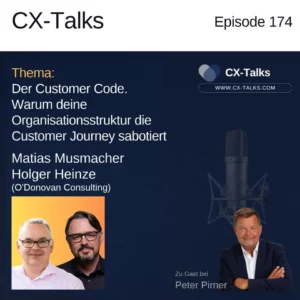
In episode 174 of CX-Talks, host Peter Pirner talks with Matias Musmacher and Holger Heinze about “The Customer Code” and why organizational structures can either enable or prevent a great customer journey.
The 67-minute conversation covers topics including:
- O’Donovan’s customer-centricity maturity model
- Conway’s Law and the Reverse Conway Maneuver
- change stability
- how to deal with organizational resistance to change
- a practical experiment involving goodwill policies in customer service
Listen to the complete episode here:
https://cx-talks.podigee.io/196-neue-episode
If you would like to explore the topic further, our article “Why Customer Centricity Fails and Why the Problem Is Rarely the Customer” takes a closer look at how organizations can turn customer knowledge into effective decisions.