When Loyalty Becomes a Real Customer Relationship
Falko May from O’Donovan Consulting joins “Travelholics – Der Podcast der Touristik”
Collect points. Receive vouchers. Install an app. Get regular newsletters.
That is how many loyalty programmes work.
There is nothing fundamentally wrong with that. An incentive can be a good reason to join a programme. Discounts, vouchers or exclusive benefits provide a tangible entry point into a customer relationship. They give customers a reason to register and share data with a company.
But that is where the real work begins.
Because a loyalty card is not yet a customer relationship.
In the latest episode of “Travelholics – Der Podcast der Touristik”, Roman Borch talks to our colleague Falko May about Customer Centricity, Customer Engagement, Loyalty and how technology is changing customer relationships in the travel industry.
At the heart of the conversation is a question that reaches far beyond tourism:
When does a customer programme actually become a relationship?
Customer knowledge begins when assumptions meet data
Falko has been working with CRM, Customer Insights and Customer Engagement for many years. During his time at Thomas Cook, his team analysed existing customer data and compared the insights with the customer profiles and assumptions that had developed within the company over the years.
Analyses like these can be sobering.
Companies often believe they know their customers extremely well. Marketing has its target groups. Sales has years of experience. Product teams believe they know what their customers want. Executives have a sense of who buys and why.
Then the data arrives.
And suddenly, some of those assumptions no longer hold true.
This is one of the central challenges of genuine customer centricity: instead of defending our existing image of the customer, we need to be willing to let actual customer behaviour correct it.
That sounds obvious. In practice, it is anything but.
Customer Centricity does not simply mean knowing more about customers. It means making different decisions based on that knowledge.
And at that point, customer centricity is no longer just a CRM or marketing topic.
It becomes an organisational one.


The customer does not experience departments
The travel industry makes the gap between the customer perspective and the organisational perspective particularly visible.
For the traveller, there is simply a journey.
It might begin with inspiration, followed by consultation, booking, preparation, departure, the stay itself and eventually the journey home.
From a company’s perspective, however, the very same journey looks completely different.
There may be a travel agency, tour operator, airline, hotel, insurer and transfer provider involved, alongside different systems, databases and responsibilities.
But the customer does not experience a system landscape.
They do not experience an organisational chart.
They experience one connected journey.
And this is precisely why Customer Experience so often breaks down at the interfaces. Every individual department can do its job well while the overall experience remains poor.
True customer centricity therefore requires organisations to stop looking at the journey through the lens of their own structures and start seeing it through the eyes of the customer.
Loyalty begins after the discount
Loyalty is also still often understood in highly transactional terms.
A customer receives a benefit.
In return, they provide data.
That can be a perfectly good deal for both sides.
But it does not automatically create loyalty.
The crucial moment comes afterwards.
What does the company actually do with the information it has gained?
Does communication become more relevant?
Are offers better tailored to the individual?
Does the company understand the customer more deeply?
Does the service match the situation?
Or does the data simply end up in another system and get used to send even more standardised communication?
A discount can encourage a customer to buy again.
A relationship begins when a company demonstrates that it understands the customer.
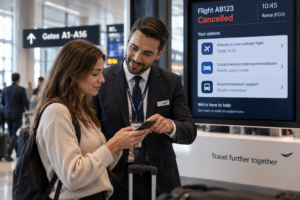
This becomes particularly visible when things go wrong.
If a flight is cancelled, a booking needs to be changed or something unexpected happens during a journey, loyalty is not determined by the customer’s points balance.
It is determined by whether the company simply informs them about the problem – or actually helps solve it.
Customers may not remember which voucher they received two years ago.
But they are very likely to remember who helped them when their journey suddenly did not go according to plan.

Why travel agencies may have a structural advantage
This creates an interesting opportunity for travel distribution.
Travel agencies often possess something that individual service providers find much harder to build:
continuity in the customer relationship.
A customer might change airlines.
They might choose a different hotel.
They might travel to a different country.
But the travel agency can remain the trusted point of contact that knows the customer’s history, preferences and needs over many years.
There is another advantage.
There are often weeks or even months between booking and departure.
From a Customer Engagement perspective, this is not simply waiting time.
It is relationship-building time.
Companies can use this period to provide relevant information, anticipate questions, build excitement and offer support.
But this only works when the communication is genuinely useful.
More communication does not automatically mean better Customer Engagement.
Context is what matters.
What does this customer need right now?
Good Customer Engagement technology is becoming more accessible
For a long time, professional CRM and Customer Engagement solutions were primarily the domain of large corporations.
That is changing.
Cloud platforms, automation, APIs and AI are significantly lowering the technological barriers to entry. This gives smaller providers the opportunity to orchestrate customer communication much more professionally.
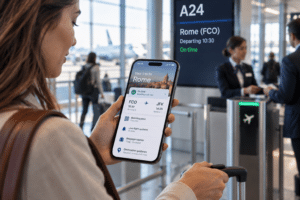
One of the topics discussed in the podcast is digital wallet passes.
At first, that may sound like a relatively minor technical feature. But it can become an interesting direct communication channel.
Travel information can be made available directly on the customer’s smartphone. Combined with data from mid-office systems and APIs, information can be personalised, while push notifications enable direct communication throughout the travel journey.
The interesting question is not:
What can the technology do?
It is:
Which customer problem are we solving with it?
That is where meaningful digitalisation separates itself from additional technological complexity.
A new tool does not automatically create a better customer experience.
It becomes relevant when it makes the relationship simpler, more helpful or more personal.

AI is moving the next frontier of Customer Engagement
Of course, it is almost impossible to have a conversation about CRM and Customer Engagement today without eventually arriving at Artificial Intelligence.
The first phase of the AI boom was heavily driven by experimentation.
What can the model do?
What can we automate?
Which proof of concept can we build?
The next phase is likely to be considerably more pragmatic.
Companies will have to ask:
Which of these applications actually deliver a return?
Where does AI genuinely improve the customer experience?
Which processes need to change?
And how should people and AI agents work together?
This becomes particularly interesting in sales.
Today, customers mainly use AI to search for information, compare offers or plan trips.
In the future, AI agents could act much more independently.
An agent working on behalf of a customer could formulate requirements and evaluate options. On the provider side, other agents could respond to those requirements, compile offers or even handle parts of the purchasing process.
This takes us towards Agentic Commerce.
Parts of the customer interaction could eventually take place between machines.
And that creates an interesting paradox:
The more communication can be automated, the more valuable genuine human interaction may become.
Perhaps humans will become the premium channel
That is one of the most interesting aspects of this development.
For years, companies have tried to replace human interactions with digital processes.
Self-service, automation, chatbots and apps can be enormously useful. Nobody needs a personal phone call every time they want to change an address.
But as simple interactions become increasingly automated, the value of the remaining human interactions may change.
An employee who genuinely listens.
A travel advisor who has known a customer for years.
A person who takes responsibility when a situation becomes complicated.
These interactions may not become less valuable.
They may become more valuable.
Perhaps genuine human interaction will become a differentiator precisely because it cannot be scaled indefinitely.
And that brings us back to the original question.
When does a customer programme become a customer relationship?
Not when the customer downloads an app.
Not when they collect their first points.
And not automatically when we possess large amounts of data about them.
A relationship develops when a company uses that information to become more relevant to the customer.
When it understands their needs.
When it helps at the right moment.
When communication is not merely automated, but meaningful.
And when the organisation is prepared to align its own processes and structures with the customer’s perspective.
That is considerably more difficult than launching a loyalty programme.
But it is probably considerably more valuable too.
Products can become interchangeable.
Technologies can too.
The customer relationship wins.
Listen to the full Travelholics episode
In the latest episode of Travelholics – Der Podcast der Touristik, Roman Borch talks to Falko May from O’Donovan Consulting in depth about CRM, Customer Centricity, Loyalty and Customer Engagement in the travel industry.
They explore why customer data can challenge long-held assumptions, why travel agencies may have a structural advantage when it comes to relationship building, the potential of digital wallet passes and how AI and Agentic Commerce could reshape the customer relationship.
→ Listen to the Travelholics episode “Loyalty”:
https://podcast.travelholics.media/426-loyalty