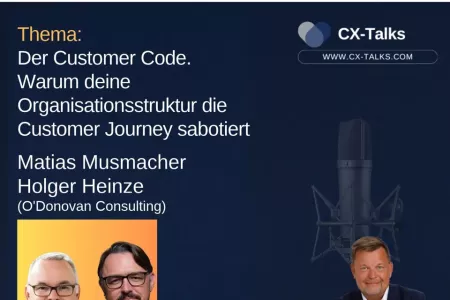
Why Customer Centricity Fails – and Why the Problem Rarely Lies with the Customer

Companies today invest more than ever in Customer Experience. Customer journeys are developed, customer feedback is analyzed, and modern technologies are introduced. Yet many initiatives still fall short of expectations.
Why?
The answer may be surprising.
The customer is not the problem.
Often, the organization is.
Companies Know Their Customers, Yet Still Fail to Act
Most companies today have access to an enormous amount of information.
They know:
- what customers expect,
- where processes are not working,
- which pain points exist,
- and where customers drop off.
Customer journeys create transparency.
NPS surveys provide metrics.
Feedback systems continuously generate insights.
And yet, many known problems persist for years.
The reason is rarely a lack of knowledge.
The real challenge is turning that knowledge into decisions.
So the key question is:
How can an organization consistently turn customer knowledge into action?

Customer Journeys Are Important – but They Don’t Change an Organization
Customer journeys are now a standard part of modern Customer Experience programs.
They help companies:
- understand their customers better,
- identify gaps and friction points,
- analyze processes,
- and uncover opportunities for improvement.
But a customer journey is, first and foremost, exactly that:
An analysis.
It does not change processes.
It does not change responsibilities.
And it does not make decisions.
Real change only begins when organizations act on the insights they have gained.

More Data Does Not Automatically Lead to a Better Customer Experience
Many companies respond to challenges by collecting even more data.
More customer feedback.
More dashboards.
More reports.
But this often makes the underlying problem even bigger.
Because there is already plenty of information available.
What is missing is a shared assessment.
Marketing looks at campaigns.
Sales focuses on conversions.
Customer service knows the complaints.
IT analyzes systems.
Every department has valuable information.
But no one has the complete picture.
Customer Centricity Is Therefore Not Created by More Data
It is created through better decisions.
Customers Do Not Experience Departments
For customers, there is no marketing.
No IT.
No sales.
And no customer service.
The customer experiences the company as a whole.
Every break between channels.
Every waiting time.
Every unclear responsibility.
Every handover.
All of these become part of the customer experience.
That is why Customer Experience is not determined by a single touchpoint.
What matters is how the entire organization works together.

Methods Help – Organizations Create Change
Customer Experience today has a wide range of established methods.
- Customer Journey Mapping
- Design Thinking
- Service Blueprinting
- Voice of the Customer
- Persona Development
All of them have value.
But no method can compensate for a lack of collaboration.
No method resolves conflicting objectives.
No method takes responsibility.
And no method makes decisions.
Methods provide direction.
Organizations turn insights into action.


Conclusion
Customer Experience rarely fails because of a lack of methods.
And even more rarely because of the customer.
It often fails because organizations do not consistently translate insights into decisions.
That is why sustainable customer centricity does not start with a new customer journey.
Not with another dashboard.
And not with the next software solution.
It starts with an organization that consistently acts from the customer’s perspective.
Because ultimately:
Organization Beats Method.
How well prepared is your organization to turn customer knowledge into effective decisions?