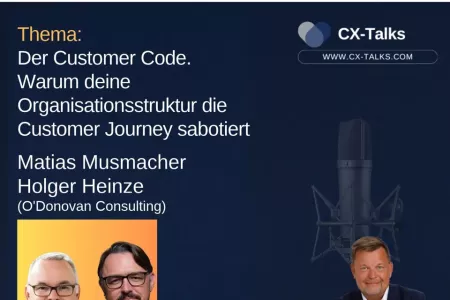
Culture in Customer Service: Why Good Employees Suddenly Make Bad Decisions
“That’s not my ticket.”
Few sentences describe corporate culture as accurately as this one.
Not because it is rude.
But because it shows how people have learned to work.
When employees pass on responsibility as quickly as possible, when complaints are automatically escalated, or when no one wants to make decisions, the problem rarely lies with the people.
It almost always lies within the system.
That is an uncomfortable realization.
Because it contradicts a widespread assumption: that poor service quality is primarily caused by employees.
In our work, we see the exact opposite.
The vast majority of people want to do good work. They want to help customers. They want to solve problems.
So when they stop doing that, we should start by asking a different question:
What kind of culture created this behavior in the first place?
Because culture is not about what is written in the company’s mission statement.
It is about what actually happens at 8:15 on a Monday morning.
Customer Service Is the Most Honest Reflection of Corporate Culture
There are few areas of a company where culture becomes as visible as it does in customer service.
This is where processes meet emotions.
Metrics meet expectations.
Internal structures meet real people.
Every phone call, every email, and every complaint reveals how an organization really works. Not on PowerPoint slides, but in everyday practice. This is exactly why culture becomes immediately visible here. It determines whether employees take responsibility or look for someone else who is responsible. Whether they develop solutions or find excuses. Whether customers build trust or lose it.
That is why corporate culture is not a “soft skill.”
It is a competitive factor.
When Reasonable People Suddenly Behave Unreasonably
One of my favorite principles from organizational development is:
Conditions shape behavior.
We regularly underestimate just how strongly systems influence our everyday actions.
Here is one example.
A consulting firm discovered that one of its specialist departments was consistently ignoring internal requests.
The conclusion was quickly drawn.
“They simply don’t want to help their colleagues.”
But the analysis revealed something entirely different.
The department’s bonuses were based exclusively on external revenue. Every hour employees spent helping internal colleagues reduced their personal bonus. Their behavior was therefore not uncooperative at all. It was a logical response to a poorly designed incentive system.
Or consider another example.
A field sales team regularly reached its monthly targets just before the end of the month.
Any additional business that could have been completed after that was pushed into the following month.
At first glance, this looked like a lack of motivation.
The reason was surprisingly simple.
The data plans on the company tablets were so limited that employees had to pay for any additional usage themselves.
Again, the behavior was not the problem.
The conditions were.
Toxic Culture Rarely Starts with Toxic People
Today, people are quick to talk about “toxic employees” or “toxic leaders.”
But in practice, we encounter toxic patterns far more often.
Tickets are passed from one person to another.
Departments work against each other.
Complaints turn into a question of blame.
Conflicts are consistently escalated upwards.
And eventually, someone says:
“That’s just how things work around here.”
That is the point at which every leader should pay attention.
Because at that moment, an isolated behavior has become part of the culture.

Why Good Leadership Is Not About Creating Harmony
Many leaders believe their most important task is to avoid conflict.
The opposite is true.
Their job is to make conflict manageable.
Because when problems can no longer be addressed openly, you do not create harmonious teams.
You create silent teams.
And silent teams do not learn.
Amy Edmondson describes this principle as psychological safety. Teams develop particularly well when employees can openly raise problems without fearing negative personal consequences. In customer service, this is precisely what determines whether mistakes are covered up or used as opportunities to improve processes in the long term.
Culture Is Shaped by Decisions, Every Single Day
Many companies invest significant amounts of money in mission statements.
They define values.
They organize workshops.
They print posters.
All of that can be useful.
But it does not create culture.
Culture is created through repeated decisions.
- What does a manager respond to first?
- Who receives recognition?
- Who gets support?
- Which behaviors are tolerated?
- Which behaviors are consistently addressed?
That is where culture develops.
Not in the strategy meeting.
But in everyday work.
Six Questions Every Customer Service Leader Should Ask
If you really want to understand the culture within your customer service organization, ask yourself these questions regularly:
- Do employees take responsibility, or do they pass it on?
- Are mistakes used as opportunities to improve, or to find someone to blame?
- Do departments support one another, or do they focus exclusively on optimizing their own KPIs?
- Does every employee understand how their work contributes to the customer experience?
- Which behaviors are regularly rewarded within my team?
- Which patterns have we tolerated for years, even though we do not actually want them?
The answers often reveal more about your organization than any employee survey.

Culture Can Be Shaped, If We Have the Courage to Look at the System
The good news is:
Culture is not destiny.
It is shaped by structures.
And that is precisely why it can be changed.
Not through motivational speeches.
Not through new posters displaying company values.
But through better leadership.
Through smarter incentive systems.
Through clear responsibilities.
And through the willingness to ask not only:
“Who made the mistake?”
But:
“Why did this behavior make sense to this person in the first place?”
That is where real organizational development begins.
Conclusion: Customers Always Experience a Company’s Culture
Customers do not see organizational charts.
They do not know your KPI systems.
They know nothing about internal conflicts of objectives.
They only experience how people behave.
And that behavior is the most visible expression of your corporate culture.
So if you want to improve customer service, do not start by thinking about new processes.
Start by looking at the conditions under which people work every day.
Because culture determines whether a problem leads to someone being blamed.
Or to a solution.
Would You Like to Develop Your Service Culture?
Whether it is customer service, leadership development, or organizational design, we help companies create the conditions in which effective collaboration becomes the natural choice.
Schedule a no-obligation initial consultation with O’Donovan Consulting.